
Contents
- 1 Instagram Carousel vs Reel vs Static Post: What Actually Works for Small Brands
- 1.1 The Core Reality: How Instagram Evaluates Formats
- 1.2 1. Instagram Reels: The Discovery Engine for Cold Reach
- 1.3 2. Instagram Carousels: The Trust Builder and High-Conversion Workhorse
- 1.4 3. Static Single-Image Posts: The Forgotten Powerhouse for Quick Clarity
- 1.5 Instagram Carousel vs Reel vs Static Post: The Side-by-Side Comparison
- 1.6 The Strategic Decision Framework: How to Choose Your Format in 30 Seconds
- 1.7 A Sustainable Weekly Content Mix for Busy Small Business Owners
- 1.8 4 Common Mistakes to Avoid with Instagram Formats
- 1.9 Conclusion: Real Strategy Over Format Guesswork
- 1.10 Frequently Asked Questions (FAQ)
Quick Strategy Summary (AEO Answer)
Selecting the right Instagram format depends on your sales funnel goal rather than algorithm trends. Instagram Reels drive cold reach and top-of-funnel discovery, Carousels build trust through high dwell time and saves, while Static Single-Image posts deliver instant clarity for offers and announcements. Small brands in India achieve maximum ROI by using a 3-post weekly mix matching content goal to format.
Instagram Carousel vs Reel vs Static Post: What Actually Works for Small Brands
If you’ve spent the last six months staring at a video editor at 11:00 PM trying to sync text transitions to a trending audio track, only to get 140 views and zero inquiry DMs, I want you to take a deep breath.
You aren’t bad at social media. You’re just trapped in the exhaustion cycle of guessing instead of using a strategy.
Every week, a new “growth guru” on Instagram uploads a bold video declaring that static posts are officially dead, carousels are the only way to get saves, or Reels are the exclusive key to algorithm favor. As a small business owner, coach, or solopreneur balancing client work, product inventory, and sales calls in Chennai or anywhere across India, trying to keep up with these conflicting rules feels like trying to hit a moving target while wearing a blindfold.
Here is the plain truth I share with every client who comes to me feeling overwhelmed: No single Instagram format is superior. Each format performs a completely different job in your sales funnel.
When you force every idea into a Reel because someone said “video is king,” or when you rely entirely on single-image quotes because they are easy to post, you leave revenue on the table. Real strategy isn’t about working 20 hours a week on content creation; it’s about knowing exactly why you are choosing a Carousel, a Reel, or a Static Post before you open Canva.
In this guide, we are stripping away algorithm mythologies and breaking down Instagram carousel vs reel vs static post performance with total clarity. You’ll learn what each format is actually built to achieve – reach, saves, engagement, and discoverability – and get a practical, non-overwhelming decision framework so you can turn followers into paying customers without burning out.
The Core Reality: How Instagram Evaluates Formats
Before comparing format mechanics, let’s address how the Instagram algorithm actually distributes content.
A common misconception among small business owners is that Instagram prioritizes one format across the entire app. You might hear people say, “Instagram is pushing Reels this month,” or “Carousels get more reach now.”
In reality, Instagram’s distribution system operates on user-specific affinity and behavioral consumption signals, as outlined in official Meta documentation on how Instagram ranking works. The algorithm evaluates content based on three primary metrics:
1. Watch Time & Dwell Time: How many seconds a user lingers on your post instead of scrolling past.
2. Signals of Value (Saves & Shares): Outbound actions highlighted in Meta Business Help Center research that signal a user found your content so useful they saved it for later or sent it to a colleague.
3. User Format Preference: If a user historically watches 80% video content, Instagram populates their Feed and Explore tab with Reels. If another user constantly swipes through multi-slide carousels and bookmarks visual guides, Instagram feeds them carousels.
This means your audience is not a monolith. By relying on a single format, you isolate a massive portion of your potential market.
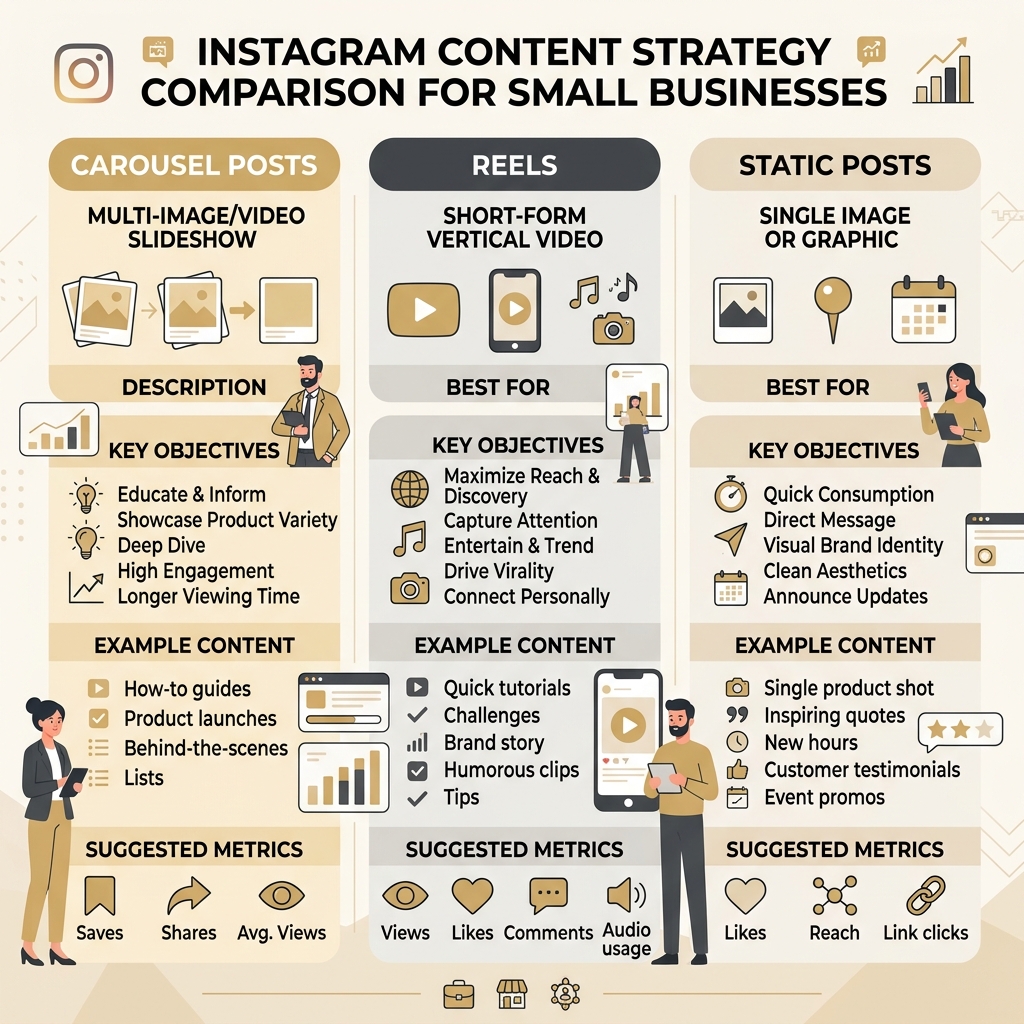
| Format | Funnel Stage | Primary Algorithm Metric | Business Goal |
|---|---|---|---|
| Reels | Top of Funnel | Watch Time & Initial Views | Cold Discovery |
| Carousels | Middle of Funnel | Dwell Time, Saves & Shares | Authority & Trust |
| Static Posts | Bottom of Funnel | Instant Clarity & CTR | Direct Action / Sales |
Understanding this funnel architecture changes everything. Instead of asking “Which format gets the most views?”, the real question is: “What business outcome do I need from this specific post?”
1. Instagram Reels: The Discovery Engine for Cold Reach
Let’s start with the format causing small business owners the most stress: Instagram Reels.
What Reels Are Actually Built For: Unearned Cold Discovery
Reels are Instagram’s primary engine for unearned reach. Unearned reach refers to views from people who do not follow your account yet. Because Reels populate the dedicated Reels tab and recommendations in the main Feed, they offer an avenue for brand discovery that static images rarely match.
If your business objective is top-of-funnel brand awareness – getting your brand name, face, or signature concept in front of thousands of local ideal clients in Chennai or across India who have never heard of you – Reels are your strongest asset.
The Hidden Catch: High Reach, Low Conversion Friction
However, high views do not automatically translate into bank account deposits.
Reels are consumed passively. Users scroll through dozens of short clips per minute.
While a Reel might generate 15,000 views, the average watch time might be 4 seconds. If your viewer swiped past before understanding what services you offer, those 15,000 views represent empty vanity numbers.
Furthermore, Reels are notorious for producing low-intent engagement. A short viral clip might garner hundreds of likes from passive viewers, but rarely builds the deep trust required for a client to invest in a – ₹50,000 coaching package or a ₹25,000 to ₹75,000 monthly retainer service or hire a retainer service provider.
When to Use Instagram Reels
– Introducing a broad industry hot-take or relatable pain point: Hook cold viewers with an empathetic hook about a challenge they face daily.
– Showcasing behind-the-scenes processes or transformations: Short video clips demonstrating physical products, office work, or client session prep.
– Teasing a high-value resource: A quick 7-second video pointing viewers to read a detailed caption or DM a keyword for a lead magnet.
When to Avoid Reels
– When explaining complex, multi-step strategic frameworks that require careful reading. – When delivering detailed tutorials where text clarity is paramount. – When you are short on time and cannot edit video without sacrificing your client delivery work.
2. Instagram Carousels: The Trust Builder and High-Conversion Workhorse
If Reels are your broad discovery megaphone, Instagram carousels are your cozy sales consultation room.
If I were forced to pick a single content format to run a service-based business or coaching practice on Instagram, I would choose carousels without hesitation.
Carousels allow you to share up to 20 slides of visual and written information in a single post. This multi-slide structure triggers three powerful algorithm advantages:
1. Massive Dwell Time: When a reader swipes through 7 to 10 slides, they spend 30 to 60 seconds engaged with your brand. Dwell time is a high-priority ranking signal for Instagram’s algorithm.
2. The Double Impression Advantage: If a follower scrolls past your carousel in their feed without swiping, Instagram frequently re-serves that exact post to them hours later, automatically starting on Slide 2. This gives you a second chance to catch their attention with a secondary hook.
3. High Intent Signals (Saves & Shares): Step-by-step visual guides, checklists, and breakdown slides encourage readers to hit “Save” for future reference or “Share” to a business partner. Saves and shares signal genuine value to the algorithm.
The Strategic Slide Blueprint for Small Brands
To make carousels work effectively for your small business, every slide must have a distinct job:
* Slide 1 (The Hook): State a compelling problem, bold myth, or desired transformation. Make it clear who the post is for.
* Slide 2 (The Empathy Bridge): Validate why traditional methods are failing the reader, establishing your authority without sounding condescending.
* Slides 3 – 7 (The Value Pillars): Break down actionable solution steps. Keep text concise, using bold typography and visual hierarchy so it’s easy to digest.
* Slide 8 (The Summary/Takeaway): Recapitulate the key lesson into an easily screenshot-able summary slide.
* Slide 9 – 10 (The Actionable CTA): Tell the reader exactly what to do next – whether that is saving the post, dropping a keyword in the DMs, or visiting your website link.
Carousels require design effort upfront, but once you build a clean brand template in Canva, they become the most reliable tool for turning casual visitors into qualified inquiries.
3. Static Single-Image Posts: The Forgotten Powerhouse for Quick Clarity
Over the past three years, single-image static posts have gotten a bad reputation. Marketers declared them obsolete, prompting thousands of business owners to stop posting images altogether.
That was a mistake.
Why Static Posts Still Excel in 2026
Static posts – whether a high-quality brand portrait, a clean graphic quote, an event announcement, or a single screenshot of a client message – serve a unique purpose that neither Reels nor Carousels can replicate: Instant, Zero-Friction Clarity.
When a follower opens Instagram on a busy morning, they don’t always have 45 seconds to swipe through a 10-slide carousel or watch a 30-second Reel with audio turned on. A static post delivers its core message in 1.5 seconds.
Key Advantages of Static Posts:
– Low Production Friction: You can design and publish a powerful static post in 10 minutes, making it your ultimate safety net when client work is busy and you need to maintain posting consistency.
– High Caption Engagement: Because the visual element is immediate, interested readers jump straight to your caption to read your story or perspective.
– Strong Personal Branding: A clean, high-resolution photo of you in your working element builds human connection faster than an abstract graphic ever can.
Best Use-Cases for Static Posts:
1. Bold Opinion Statements: A single text-graphic highlighting a core philosophy of your business (e.g., “Why I tell my clients to stop posting 7 days a week”).
2. Social Proof & Client Wins: A screenshot of a text message from a client celebrating a milestone, accompanied by a caption explaining the strategy behind that result.
3. Direct Offers & Event Announcements: A clear graphic stating “3 Retainer Slots Open for Next Month” or announcing an upcoming workshop.
Instagram Carousel vs Reel vs Static Post: The Side-by-Side Comparison
To give you a birds-eye view of how these formats compare across operational and algorithmic factors, examine the comparison matrix below:
| Feature / Metric | Instagram Reels | Instagram Carousels | Static Single-Image |
|---|---|---|---|
| Primary Funnel Purpose | Top of Funnel (Discovery) | Middle of Funnel (Nurture/Trust) | Bottom of Funnel / Quick Clarity |
| Audience Reach Type | High Unearned Cold Reach | High Warm & Follower Reach | High Existing Follower Reach |
| Algorithm Priority Signal | Watch Time & Replays | Dwell Time & Swipes | Instant CTR & Caption Read |
| Primary Engagement Metric | Views, Likes, Audio Shares | Saves, DM Shares, Bookmark Hits | Comments, Direct Replies, Clicks |
| Lead Qualification Potential | Low to Moderate | High to Very High | Moderate to High |
| Creation Effort Required | High (Filming + Editing) | Moderate (Slide Design) | Low (Single Visual + Caption) |
| Shelf Life in Feed | Long (Pushed via Recommendations) | Long (Re-served via Slide 2) | Short to Moderate |
| Best Format For | Broad awareness & relatable hooks | Educational frameworks & guides | Brand announcements & quick takes |
The Strategic Decision Framework: How to Choose Your Format in 30 Seconds
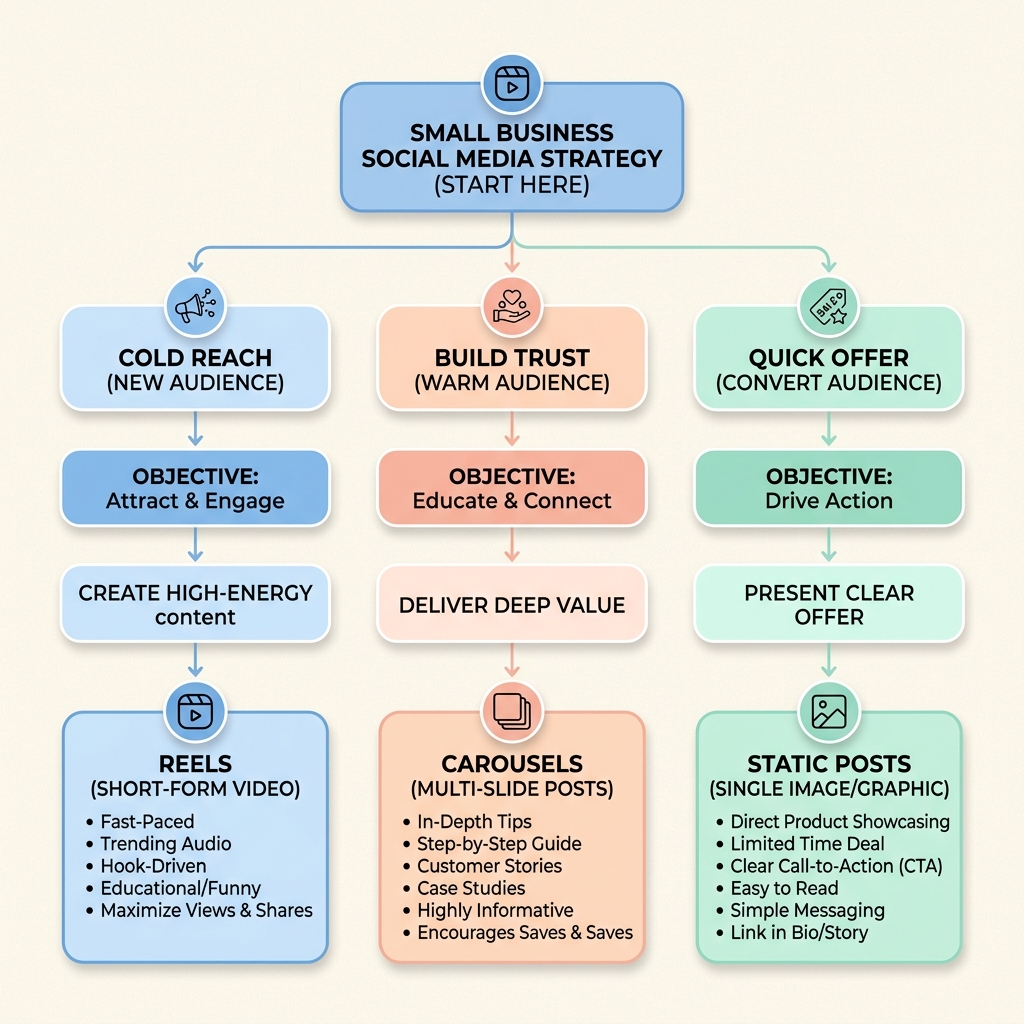
Stop asking “What format should I post today?” and start using this decision model based on your content goal:
What is Your Primary Goal for This Post?
“I need new local clients in Chennai/India to discover my brand.”
“I want to explain a step-by-step strategy in depth to warm leads.”
“I have an open spot, client win, or quote to share immediately.”
Scenario A: You want to attract 500 new local followers in Chennai this month
* Selected Format: Instagram Reel
* Strategy: Create a 12-second video addressing a common mistake local service providers make with their Instagram bios. Keep it punchy, use clear text on screen, and end with a caption CTA inviting them to follow for practical strategy.
Scenario B: You want to position yourself as an expert so prospects stop price-shopping your packages
* Selected Format: Instagram Carousel
Strategy: Create a 7-slide carousel titled “The 4-Step Content System My Clients Use to Turn Followers into Retainer Clients.”* Walk through each phase step-by-step. The depth of value proves your expertise and drives saves.
* Selected Format: Static Post
Strategy: Post a professional, warm portrait of yourself working at your desk. Use a bold image headline like “2 Strategy Slots Open for Q3.”* Write a detailed, transparent caption explaining who the service is for, what is included, and how to DM you the word “STRATEGY” to apply.
A Sustainable Weekly Content Mix for Busy Small Business Owners
One of the biggest mistakes solopreneurs make is copying generic templates (if you are planning your week, check out my guide on 6 Best Social Media Posting Schedules for Small Business Pages). You do not need to post 7 days a week, and you certainly do not need to produce 5 Reels every week to see consistent business results.
Here is a practical, 3-post-per-week content system designed for high ROI without burnout:
The 3-Post Weekly Blueprint (High Yield, Sustainable)
* Post 1 (Tuesday): The Discovery Reel (Top of Funnel)
Time investment:* 30 – 45 minutes.
Objective:* Reach new prospective clients with a broad, relatable industry insight or short video.
* Post 2 (Thursday): The Authority Carousel (Middle of Funnel)
Time investment:* 45 – 60 minutes (using pre-saved Canva templates).
Objective:* Build deep trust, drive saves, and demonstrate your strategic framework.
* Post 3 (Saturday): The Conversion Static Post (Bottom of Funnel)
Time investment:* 15 – 20 minutes.
Objective:* Share a client win, personal story, or direct offer with a clear DM call to action.
Total Weekly Content Creation Time: ~2 hours.
By sticking to this structured mix, you cover every stage of the customer journey – attracting cold viewers, nurturing warm prospects, and converting hot leads – while preserving your energy to deliver outstanding work for your actual clients.
4 Common Mistakes to Avoid with Instagram Formats
Even with the best intentions, small business owners often fall into mechanical errors that kill their engagement across all three formats. Here are four specific pitfalls to eliminate today:
1. Cramming an Entire Essay into a Reel Video
Video is meant to be consumed dynamically. If your Reel consists of 15 seconds of you sitting silently while a 200-word paragraph scrolls down the screen in tiny font, viewers will scroll away. Keep video text to punchy 5-word phrases and move long explanations into your caption or a carousel format.
2. Making Carousels Look Like Text-Heavy Textbooks
While carousels are built for depth, no one opens Instagram to read a dense white paper printed on a 1080×1350 graphic. Maintain large font sizes (minimum 28pt for body text), generous white space, and restrict each slide to one key idea. If a slide looks crowded, split it across two slides.
3. Posting Static Images Without a Story in the Caption
A beautiful single photo without context is a missed strategic opportunity. If you post a static photo, your caption must carry the weight of the post. Share the background story behind the image, share a lesson learned, or explain how that moment applies to your client’s struggle.
4. Forgetting the Call to Action (CTA)
Never leave your reader hanging at the end of a great post. Whether it is a Reel, Carousel, or Static Post, explicitly tell your reader what action to take next: – “Save this post for your next content batching session.” – “Send me a DM with the word AUDIT to discuss your strategy.” – “Share this with a fellow coach who is tired of guessing.”
Conclusion: Real Strategy Over Format Guesswork
The debate over Instagram carousel vs reel vs static post is not about finding a magic format that pleases an algorithm. It is about matching your business goals with the right tool for the job.
* Use Reels when you want to expand your reach and introduce your brand to cold audiences.
* Use Carousels when you want to establish authority, deliver immense value, and earn saves.
* Use Static Posts when you need swift production, personal connection, and direct offer clarity.
When you align your content formats with a purposeful sales funnel, content creation stops feeling like an exhausting guessing game and starts operating as a predictable growth engine for your business.
Frequently Asked Questions (FAQ)
What is the difference in reach between Instagram Reels and Carousels?
Instagram Reels typically generate higher unearned reach from non-followers because they are distributed heavily through the Reels tab and Explore recommendations. Carousels generate higher dwell time and engagement depth from your existing followers and warm prospects, making them superior for building trust and driving saves.
Are single-image static posts dead on Instagram in 2026?
No, static single-image posts are not dead. While they do not receive the same algorithm recommendation push as Reels, static posts offer zero-friction readability and remain highly effective for personal branding photos, short quotes, social proof screenshots, and quick business announcements.
How many slides should an Instagram carousel have for maximum engagement?
Carousels can contain up to 20 slides, but the optimal length for small business content strategies is typically 7 to 10 slides. This range provides enough depth to deliver thorough value without overwhelming the reader, while maximizing the dwell-time signals sent to the algorithm.
Which format converts followers into paying clients best?
Instagram Carousels and high-context Static Posts generally convert followers into paying clients better than Reels. While Reels bring cold visitors into your funnel, carousels pre-qualify prospects by demonstrating step-by-step expertise, giving readers the confidence needed to inquire about high-ticket services or coaching.
Need help building a strategic content engine for your business that turns followers into paying clients without taking over your life? Learn more about Latika Jain’s story and strategy approach or explore Social Media Management Services(https://latikajain.com/services/) or book a free discovery call today.