

Contents
- 1 Why Social Media Vanity Metrics Don’t Matter (And What to Track Instead)
- 1.1 Introduction: The 10,000-Follower Illusion
- 1.2 What Are Social Media Vanity Metrics (And Why Are They Dangerous?)
- 1.3 The “Growth That Is Built to Last” Philosophy: Strategy Over Guesswork
- 1.4 4 Social Media Metrics That Actually Matter (And How to Track Them)
- 1.5 Comparison: Vanity Metrics vs. Actionable Business Metrics
- 1.6 Step-by-Step: How to Audit Your Analytics in 15 Minutes a Week
- 1.7 Frequently Asked Questions (FAQ)
- 1.7.1 What is the difference between vanity metrics and actionable metrics?
- 1.7.2 Is follower count completely useless for a small business?
- 1.7.3 How often should a small business owner check social media analytics?
- 1.7.4 How can a local business in Chennai track offline sales coming from Instagram or LinkedIn?
- 1.8 Conclusion: Build Growth That Is Built to Last
Why Social Media Vanity Metrics Don’t Matter (And What to Track Instead)
Answer Summary (AEO Quick Take): Social media vanity metrics — such as follower counts, likes, and raw video views — measure public attention rather than commercial intent. They create a false impression of business success while failing to predict revenue or customer retention. Small business owners should track actionable social media metrics instead: engagement quality (saves, shares, inbound DMs), social-to-lead generation rates, customer acquisition cost (CAC), and repeat customer conversion.
—
Introduction: The 10,000-Follower Illusion
Last month, a small business owner in Chennai reached out to me during a consultation. Her Instagram account had just crossed 12,000 followers. Her reels were getting decent views, friends were sending congratulatory messages, and on paper, her brand looked like an overnight success story.
Then she opened her accounting sheet.
Despite the follower spike, her monthly sales were flat. Her direct messages were filled with “Price please?” comments from people who never bought, and her website conversion rate sat stubbornly near zero. She was spending four hours every evening filming trending reels, editing captions, and checking notifications every ten minutes — yet her business felt more fragile than ever.
If that story hits a little too close to home, I want you to take a deep breath. You are not failing at social media. You have simply been handed the wrong scoreboard.
In the world of online marketing, we are conditioned to chase numbers that look impressive in public but mean almost nothing in private. We celebrate likes, follower counts, and viral reach because platform algorithms design them to give us a quick hit of dopamine. But as a solopreneur, coach, or small business owner, dopamine doesn’t pay your GST, hire your team, or secure your family’s future. Understanding why social media vanity metrics fail to drive sales is the first step toward building a sustainable strategy.
My entire approach to social media management and content strategy is anchored in one simple principle: Growth That Is Built to Last. (Learn more about my background and methodology on my About Me page). That means replacing guesswork, endless posting burnout, and vanity metrics with real, sustainable business strategy.
In this guide, I am going to walk you through exactly why social media vanity metrics are lying to you, what metrics you should actually be tracking inside your analytics dashboard, and how to build a simplified tracking system that connects your social media effort directly to bankable business growth.
—
What Are Social Media Vanity Metrics (And Why Are They Dangerous?)
A social media vanity metric is any public metric — such as likes, followers, or impressions — that provides a surface-level illusion of popularity without measuring true commercial demand or business health.
Before we dive into what you should measure, let’s get clear on what a vanity metric actually is. A vanity metric is any data point that makes you feel good or look popular on the surface, but fails to provide actionable insight into whether your business is actually making money, building customer loyalty, or growing sustainably.
Here are the most common social media vanity metrics that trap small business owners:
1. Total Follower Count: The sheer number of accounts hitting “Follow” on your profile.
2. Post Likes & Hearts: The tap of a button from someone scrolling through their feed at 11 PM.
3. Video Views & Reel Impressions: Raw counts of how many screens loaded your video for more than 3 seconds.
4. Overall Impressions / Reach: The total number of times your content appeared on someone’s screen.
The Problem with Public Scoreboards
Why are these numbers so dangerous? Because they confuse attention with intent. Evaluating follower count vs engagement reveals that high visibility rarely guarantees actual purchasing decisions. Industry research from Sprout Social’s Index Report confirms that engagement depth and direct messaging correlate far more strongly with customer retention than raw reach.
When you publish a reel using a trending audio clip or a funny viral meme, Instagram’s algorithm might push it to 50,000 people across India. Your notifications blow up. You get hundreds of likes. It feels like victory.
But if those 50,000 viewers consist of teenagers in other cities who have zero intention of hiring a Chennai-based consultant, buying your handmade products, or booking your premium coaching program, that viral reach contributed exactly zero rupees to your bottom line. In fact, it cost you time, energy, and focus that could have been spent engaging five ideal clients who actually need what you offer.
Furthermore, platform algorithms are constantly shifting. Relying on follower count as your primary benchmark creates a false sense of security. If Instagram changes its distribution model tomorrow — as it routinely does — those 15,000 followers might only see 2% of your posts unless you pay for ads or create highly intentional, high-salience content.
When you measure success by social media vanity metrics, you make bad strategic decisions:
* You start creating content for the algorithm rather than for your ideal buyer.
* You prioritize high-volume entertainment over deep authority building.
* You mistake high engagement on non-commercial posts for genuine commercial demand.
* You burn out trying to maintain an unsustainable posting schedule just to keep arbitrary numbers moving up.
Real strategy means looking past the surface noise. Let’s talk about what happens when you change your focus to actionable social media metrics.
—
The “Growth That Is Built to Last” Philosophy: Strategy Over Guesswork
The “Growth That Is Built to Last” philosophy replaces guesswork with intentional content strategy designed to convert targeted followers into paying clients.
If vanity metrics are a trap, what is the alternative?
The alternative is what I call intent-based content strategy.
When I work with small business owners and coaches across India, we don’t start by setting a goal like “Let’s gain 5,000 followers this quarter.” Instead, we ask foundational business questions:
* How many qualified leads do you need each month to hit your revenue targets?
* What specific problem brings a customer to your business, and how does your content prove you can solve it?
* What action do we want an interested viewer to take after reading a post?
When your content is grounded in real strategy rather than guesswork, your relationship with metrics completely flips. You stop caring whether a post got 500 likes or 50 likes. Instead, you care whether that post generated three thoughtful direct messages from qualified business owners asking how to work with you. If you’re evaluating strategic help for your brand, check out my guide on 7 smart questions to ask before hiring a social media expert.
A small, focused audience of 800 highly targeted local followers who trust your expertise will outperform an unfocused audience of 50,000 casual scrollers every day of the week. Establishing meaningful social media engagement ensures that every interaction moves the prospect closer to a buying decision.
Let me break down the four core metrics that actually drive sustainable business growth.
—
4 Social Media Metrics That Actually Matter (And How to Track Them)
The four social media metrics that matter most for business growth are engagement quality, social-to-lead generation rate, social conversion rate/CAC, and community retention rate.
If you want to measure whether your social media efforts are translating into business value, stop looking at likes and start tracking these four actionable metrics.

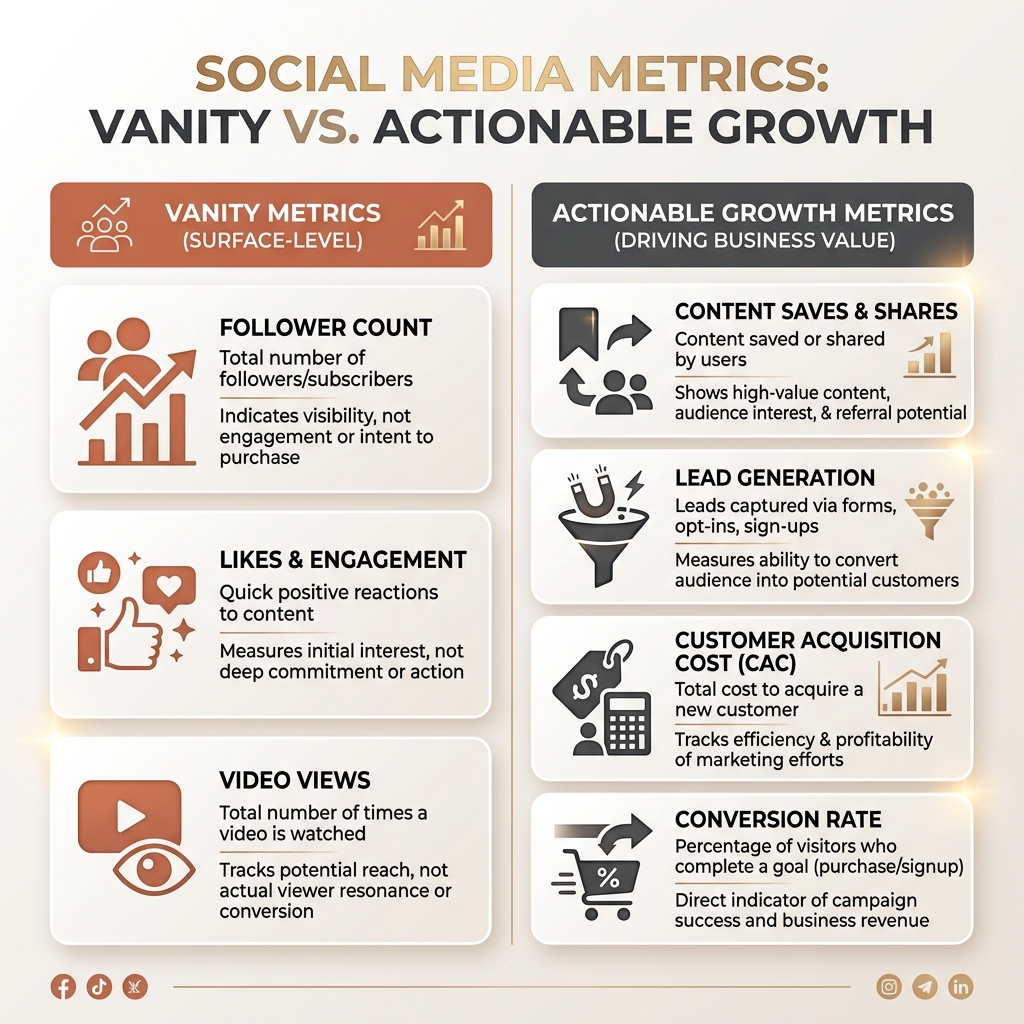
| Vanity Metrics (Look Good, Low Commercial Value) | Actionable Metrics (Drive Real Business Growth) |
|---|---|
| Total Follower Count | Engagement Quality (Saves, Shares, Inbound DMs) |
| Post Likes & Hearts | Social-to-Lead Generation Rate |
| Raw Video Views & Impressions | Social Conversion Rate & Customer Acquisition Cost (CAC) |
| Surface Impressions | Community Retention & Repeat Customer Growth |
Metric #1: Engagement Quality (Depth Over Distance)
Engagement quality measures depth of interest through saves, shares, and qualified direct messages rather than surface-level likes.
Not all engagement is created equal. A “heart” emoji in your comments section requires zero thought from the viewer and offers zero commitment. A saved post, a bookmark, or an in-depth direct message, on the other hand, indicates high buyer intent and genuine trust.
What to Track within Engagement Quality:
Saves & Bookmarks: When someone saves your post, they are saying, “This advice is so valuable that I need to come back to it when I am ready to implement.”* In educational and strategic niches, high saves directly correlate with authority and expertise.
* Shares & DMs Sent via Content: When a user sends your post to a business partner or friend with a note saying “We should look into this,” your content has crossed from entertainment into active recommendation.
* Inbound Conversation Starters: Measure how many direct messages or detailed comments you receive that ask specific questions about your process, offer, or perspective.
How to calculate Engagement Quality:
Look at your platform analytics (e.g., Instagram Insights or LinkedIn Analytics) every 14 to 30 days. Divide your total high-intent interactions (Saves + Shares + Inbound Strategic DMs) by your total reach for that period:
(
Saves + Shares + Qualified Inbound DMs
Total Reach
)
× 100
If this ratio is rising, your messaging is resonating deeply with people who value your expertise — even if your overall follower growth looks slow on the surface.
—
Metric #2: Social-to-Lead Generation Rate
Social-to-lead generation rate tracks how effectively social media traffic converts into email subscribers, WhatsApp leads, and discovery call bookings.
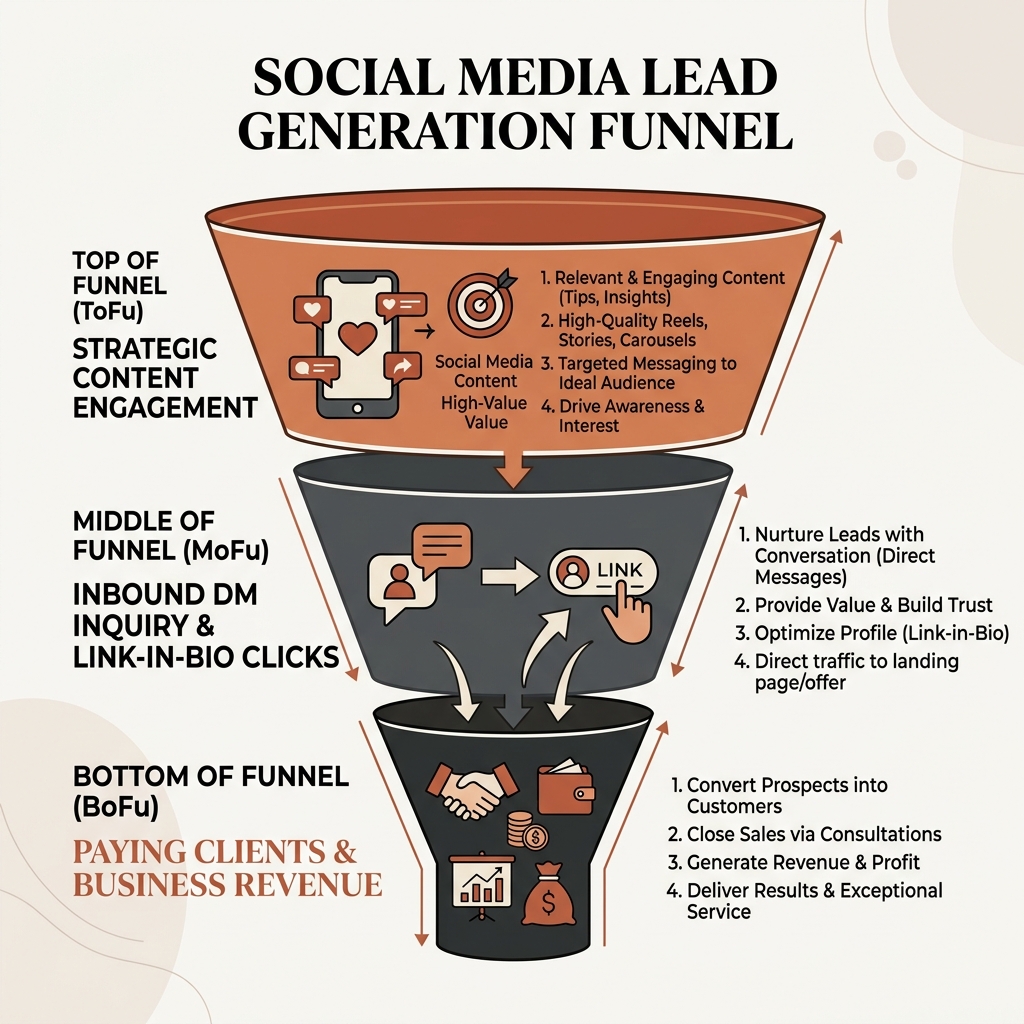
Social media is not the end of your marketing funnel; it is the front door. If your social content does not guide interested viewers off the platform and into your owned marketing channels (such as an email list, a WhatsApp business broadcast, a discovery call booking system, or a direct website contact form), you are renting an audience on land you don’t own. Establishing strong social media lead generation metrics connects social engagement directly to sales pipeline growth. For official guidelines on setting up event tracking and conversion goals, refer to the Google Analytics Lead Tracking Guide.
What to Track for Lead Generation:
* Link-in-Bio Clicks: How many visitors click through to your website, booking link, or lead magnet from your profile page?
* Lead Magnet Downloads / Sign-ups: If you offer a free checklist, strategy guide, or newsletter, how many sign-ups originate directly from social traffic?
* Direct Inquiry Submissions: Track how many clients state “found you on Instagram” or “read your LinkedIn post” when filling out your onboarding form.
How to calculate Social-to-Lead Generation Rate:
Track your monthly profile visits against total outbound clicks or inquiries:
(
Outbound Link Clicks / Inquiries
Total Profile Visits
)
× 100
A healthy profile conversion rate tells you that your bio, pinned posts, and call-to-action (CTA) structure are doing their job: turning curious visitors into identified prospects.
—
Metric #3: Social Conversion Rate & Customer Acquisition Cost (CAC)
Social conversion rate measures the percentage of social inquiries that become paying clients, while Customer Acquisition Cost (CAC) tracks the total cost required to win each client.
Now we get to the heart of business sustainability: money in the bank.
It does not matter if your content generates 100 leads a month if none of those leads turn into paying customers. Similarly, if you are spending ₹50,000 a month in time or ad budget to acquire a single client worth ₹10,000, your strategy is economically unsustainable. Calculating your social media conversion rate ensures that your time investment generates positive financial ROI.
What to Track for Conversions:
* Social Sales Revenue: The total gross revenue generated from clients who entered your pipeline through social media channels.
* Lead-to-Client Conversion Rate: The percentage of social inquiries that turn into signed contracts or paid orders.
* Effective Time/Cost per Client: The total resources (hours spent creating content + agency/freelance fees + ad spend) required to win one paying client through social media. Knowing your social media ROI India benchmarks allows solopreneurs to price services with confidence.
Formula for Social Media Customer Acquisition Cost:
Total Monthly Social Investment (Time Value + Tools + Ad Spend)
Number of Paying Clients Acquired via Social
When you know your CAC and compare it against your average client value or package price, you gain complete clarity. You no longer have to guess whether your social media efforts are working — you have mathematical proof.
—
Metric #4: Community Retention & Repeat Customer Rate
Community retention measures how effectively social content maintains relationships with existing clients and drives repeat purchases.
Acquiring a new client or customer always costs more time and energy than retaining an existing one. High-performing social media strategy does not just attract new strangers; it nurtures existing clients, builds long-term brand equity, and drives repeat business.
What to Track for Community Retention:
* Repeat Engagement from Past Clients: Are previous clients continuing to interact with your posts, share your content, and leave testimonials?
* Client Advocacy & Referrals: How often do existing followers or past clients tag your handle when someone in their network asks for a recommendation in your niche?
* Customer Lifetime Value (LTV) from Social Channels: Do clients acquired via social media stay with you longer or buy higher-tier services compared to clients from other sources?
When your content consistently educates and reinforces your position as an approachable expert, existing clients feel reassured in their decision to hire you, and referral word-of-mouth accelerates organically.
—
Comparison: Vanity Metrics vs. Actionable Business Metrics
To help you audit your current social media focus, review this direct comparison chart:
| Metric Category | Vanity Metric (Stop Obsessing Over) | Actionable Metric (Start Tracking Today) | Business Impact |
|---|---|---|---|
| Audience Growth | Total follower count | Profile-to-lead conversion rate | Measures how effectively your profile turns visitors into potential clients. |
| Content Performance | Total likes & hearts | Total saves, shares, & bookmark rates | Proves whether your content provides real strategic value or just fleeting entertainment. |
| Reach & Distribution | Raw video views & impressions | Qualified inbound DMs & inquiry volume | Distinguishes between random crowd attention and targeted buyer interest. |
| Financial Return | Viral post frequency | Social CAC & Lead-to-Client Conversion | Provides clear proof of financial ROI from your social media time and capital. |
| Brand Equity | Public comment volume (emojis) | Client referrals & repeat customer mentions | Builds long-term brand authority and sustainable organic growth in your local market. |
—
Step-by-Step: How to Audit Your Analytics in 15 Minutes a Week
Auditing your social media analytics requires setting up a simple spreadsheet, conducting a monthly content save audit, evaluating profile links, and eliminating non-converting content types.
You don’t need expensive analytics software or hours of spreadsheet work to track what matters. Here is a simple, 4-step weekly routine you can implement starting today.
Step 1: Set Up a Simple Tracking Sheet
Create a basic spreadsheet (Google Sheets works perfectly) with five columns:
1. Date / Week
2. Total Profile Clicks
3. Total Content Saves & Shares
4. Inbound Strategic DMs / Inquiries
5. New Signed Clients from Social
Step 2: Conduct a Monthly Content Audit
At the end of every 30 days, look at your top 3 performing posts by Saves and Shares (not likes). Ask yourself:
* What specific topic or format did these posts cover?
* Did they address a clear client pain point or offer a practical framework?
* How can I create deeper follow-up content around these exact themes?
Step 3: Audit Your Lead Conversion Pathway
Look at your Instagram bio or LinkedIn profile page with fresh eyes:
* Is your value proposition crystal clear in the first two lines?
* Does your profile link lead directly to a clean, mobile-responsive page where visitors can easily contact you or book a call?
* Is there any friction preventing an interested prospect from reaching out?
Step 4: Cut the Noise & Focus on Intent
If a specific content type (like funny trending reels) brings in hundreds of likes but zero qualified inquiries, reduce the time you spend on it. Reallocate those hours toward high-intent content formats — such as case studies, step-by-step strategic breakdowns, client transformation stories, and clear Q&A posts addressing common buyer objections.
—
Frequently Asked Questions (FAQ)
What is the difference between vanity metrics and actionable metrics?
Vanity metrics (like follower counts, likes, and raw video views) look impressive publicly but do not indicate whether your business is growing financially. Actionable metrics (like content saves, lead generation rates, inbound DMs, and customer acquisition costs) directly correlate with brand authority, qualified inquiries, and revenue.
Is follower count completely useless for a small business?
Follower count is not entirely useless, but it is secondary. A baseline audience gives you initial social proof, but high follower numbers mean nothing if those followers do not align with your target audience or convert into paying clients. Focus first on audience alignment and conversion quality before worrying about audience scale.
Checking analytics daily often leads to knee-jerk decisions and anxiety based on algorithm fluctuations. It is best to review your key actionable metrics once a week for basic tracking, and perform a deeper content and lead audit once every 30 days to guide your ongoing strategy.
How can a local business in Chennai track offline sales coming from Instagram or LinkedIn?
You can track offline conversions by incorporating simple attribution mechanisms: ask every new client “How did you hear about us?” on your intake form, offer an exclusive social-only mention code or booking link, or track direct messages where prospects initiate local consultations.
—
Conclusion: Build Growth That Is Built to Last
Social media should be a powerful asset for your business, not a source of constant overwhelm and guesswork.
When you stop chasing social media vanity metrics and start building a strategy focused on engagement quality, lead generation, and genuine customer relationships, everything gets easier. You spend less time filming random trends, and more time delivering exceptional value to clients who respect your expertise.
If you are a small business owner, coach, or solopreneur in Chennai or across India who is ready to replace social media guesswork with a clear, strategic roadmap that drives visible revenue growth, I am here to help. Explore my social media management package to learn how we can work together.
Ready to stop chasing likes and start building real business strategy? Let’s connect and create a tailored social media management plan designed specifically for your brand’s long-term success.
—